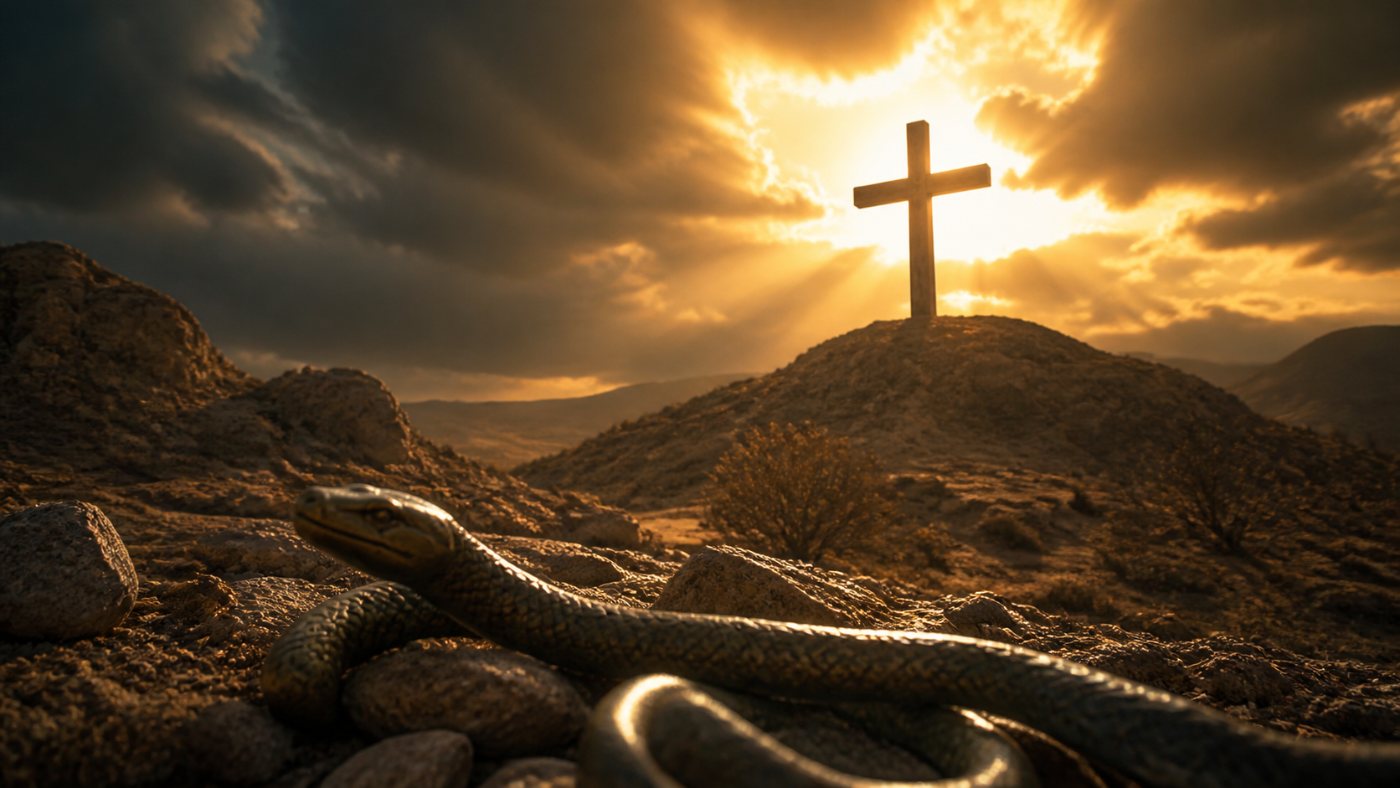
There was a moment when humanity had everything.
A garden. Presence. Direct communion with God. And a tree whose fruit meant that death would never have the final word.
Then came the serpent.
And with it, the oldest poison in the world: the doubt that God truly wants what is good for you.
"The thief does not come except to steal, and to kill, and to destroy. I have come that they may have life, and that they may have it more abundantly."
(John 10:10)
Jesus did not say that in a vacuum. He said it against the backdrop of a story that had been unfolding for centuries. A story that begins in a garden, passes through a wilderness, and ends — though many still do not realize it — at a cross raised as a sign of life.
What Was Lost in the Garden
The serpent did not go straight for the fruit. It went for trust.
"Has God indeed said, 'You shall not eat of every tree of the garden'?"
(Genesis 3:1)
A single question. Planted with precision. And with it, the poison began to flow.
It was not fangs that killed humanity. It was doubt.
The doubt that God is holding you back. That He is keeping something good from you. That His commands are chains and not protection. And when the man and the woman bit into that fruit, they did not merely disobey an order — they disconnected themselves from the very source of life.
Then came the sentence. Not as cruelty, but as consequence:
"So He drove out the man; and He placed cherubim at the east of the garden of Eden, and a flaming sword which turned every way, to guard the way to the tree of life."
(Genesis 3:24)
The tree of life was blocked.
The turning sword was not a decorative image. It was the heaviest reality humanity would ever carry: we had lost access to eternal life.
And from that day forward, everything in the story of redemption points to one single question: How do we find our way back?
The Wilderness Has Serpents Too
Centuries later, the people of Israel were making their way through the wilderness and began to grumble.
They had manna from heaven and water from the rock. They had the pillar of fire by night and the cloud by day. But they grew weary of the journey. They grew weary of the process. And they opened their mouths to complain against God and against Moses:
"Why have you brought us up out of Egypt to die in the wilderness?"
That sounds familiar, doesn't it?
When the process drags on. When the answer does not come. When the promise seems to grow further away with every passing day. There is something in the human heart — wounded since the garden — that still whispers the same old lie: God does not want what is good for you. God has abandoned you here.
And then the fiery serpents came. The people were dying. The poison was spreading.
But God, in His mercy, gave an instruction that made no human sense at all:
"Make a fiery serpent, and set it on a pole; and it shall be that everyone who is bitten, when he looks at it, shall live."
(Numbers 21:8)
Moses obeyed. He raised the bronze serpent. And everyone who was dying — if they looked, they lived.
No medicine. No complicated ritual. No list of requirements.
Just look.
Jesus Saw the Whole Story in That Image
When Nicodemus came to Jesus by night — confused, searching, not quite knowing what to ask — Jesus did not give him an abstract theology lecture. He gave him a picture:
"And as Moses lifted up the serpent in the wilderness, even so must the Son of Man be lifted up, that whoever believes in Him should not perish but have eternal life."
(John 3:14–15)
Jesus was saying something radical.
What happened in the wilderness was not an isolated episode. It was an enacted prophecy. A foretaste. A sign pointing toward the moment when He Himself would be lifted up on a cross — bearing upon Himself all the poison, all the death, all the condemnation that sin had unleashed since the garden.
"For the wages of sin is death, but the gift of God is eternal life in Christ Jesus our Lord."
(Romans 6:23)
A man in the wilderness was dying. He looked at the bronze serpent. And he lived.
A sinner laden with death looks to Christ crucified, believes in Him. And lives.
The mechanism is the same. The grace is greater.
What Adam Lost, Christ Restored
Romans 5 says it with a clarity that takes your breath away:
"For as by one man's disobedience many were made sinners, so also by one Man's obedience many will be made righteous... so that as sin reigned in death, even so grace might reign through righteousness to eternal life through Jesus Christ our Lord."
(Romans 5:19, 21)
One man opened the door to death. Another man closed it.
One man disobeyed God in a garden. Another obeyed unto death on a cross — also in a garden, Gethsemane, where He sweat drops of blood in order to say, "Not My will, but Yours be done."
The serpent of Eden promised knowledge. Christ from the cross offers life.
And at the end of the book, when the story reaches its conclusion, the tree of life appears once more:
"Blessed are those who do His commandments, that they may have the right to the tree of life, and may enter through the gates into the city."
(Revelation 22:14)
The turning sword is gone. The cherub no longer blocks the way. Because access was reopened — not by human effort, but by the blood of the Lamb.
You Only Have to Look
The people in the wilderness did not manufacture the antidote. They did not climb up to reach the bronze serpent. They did not complete a process of earning merit.
They simply looked.
And you — perhaps you come to these words carrying the poison of years of wrong choices, of broken relationships, of guilt that will not let you sleep, of a life that feels so far from the garden God dreamed for you:
There is One who has been lifted up for you.
The Cross was not an accident of history. It was the most precise answer heaven could give to the oldest wound in the human soul.
"And the Spirit and the bride say, 'Come!' And let him who hears say, 'Come!' And let him who thirsts come. Whoever desires, let him take the water of life freely."
(Revelation 22:17)
Freely.
Without deserving it. Without fixing yourself first. Without understanding everything. Just come.
Eternal life is not a prize waiting at the end of the road. It is a reality that begins the moment you look to Christ and believe that He is enough to pay what you owed.
That is the gospel.
He did not come to condemn you. He came to save you.
And the invitation is still open — today, right now — for anyone who is thirsty.
Have you been carrying the poison for a long time, not knowing that the antidote already exists? Today you can look. Today you can come.


