There is an enormous difference between being alive and having life.
You can breathe. You can work, eat, sleep, get up and do it all over again. You can meet your commitments, show up in all the places you're supposed to be, smile in the photos. And still carry inside you a dryness you don't know how to name. A void that neither success fills nor rest relieves.
It isn't necessarily depression. It's something deeper.
It's the absence of what you were designed to have.
"The thief does not come except to steal, and to kill, and to destroy. I have come that they may have life, and that they may have it more abundantly."
(John 10:10, NKJV)
Jesus did not come to give you a religion. He did not come to give you a code of behavior or a checklist of duties. He came to give you life. Life in abundance. Life that overflows.
And to understand the weight of that promise, you must first understand what was lost.
What the Garden Had and We Lost
In the beginning, God planted a garden. And in the middle of that garden He placed a tree. Not just any tree: the tree of life.
The human being had access to it. He had communion with God, a clear identity, purpose without confusion. He had life—not as a theological concept, but as a lived, breathed, enjoyed reality.
Then the serpent came.
It did not come with violence. It came with a question. With an insinuation. With the suggestion that God was hiding something from them, that they could be more than they already were, that obedience was a cage and not a protection.
"You will not surely die..."
(Genesis 3:4, NKJV)
That was the lie. And they believed it.
The result was not freedom. It was expulsion. Shame. Separation. And a flaming sword turning in every direction, blocking the way to the tree of life.
Sin did not only separate us from God. It separated us from life itself.
Romans says it plainly:
"Therefore, just as through one man sin entered the world, and death through sin, and thus death spread to all men, because all sinned."
(Romans 5:12, NKJV)
This is not an ancient story that doesn't affect you. It is your story. It is my story. We are all born carrying that inheritance: death as a background condition, as a constant noise we can never quite silence.
A Serpent in the Desert and a Sign That Pointed Further
Centuries after the garden, the people of Israel were walking through the wilderness. And they grew weary. They complained against God. They spoke with bitterness, with impatience, with ingratitude.
And the serpents came.
The bites were deadly. People were dying. Panic spread through the camp. And then the people ran to Moses with what they should have said from the very beginning: "We have sinned. Pray for us."
God's response was strange. He did not send medicine. He did not send an angel to heal the wounded. He sent this:
"Make a fiery serpent, and set it on a pole; and it shall be that everyone who is bitten, when he looks at it, shall live."
(Numbers 21:8, NKJV)
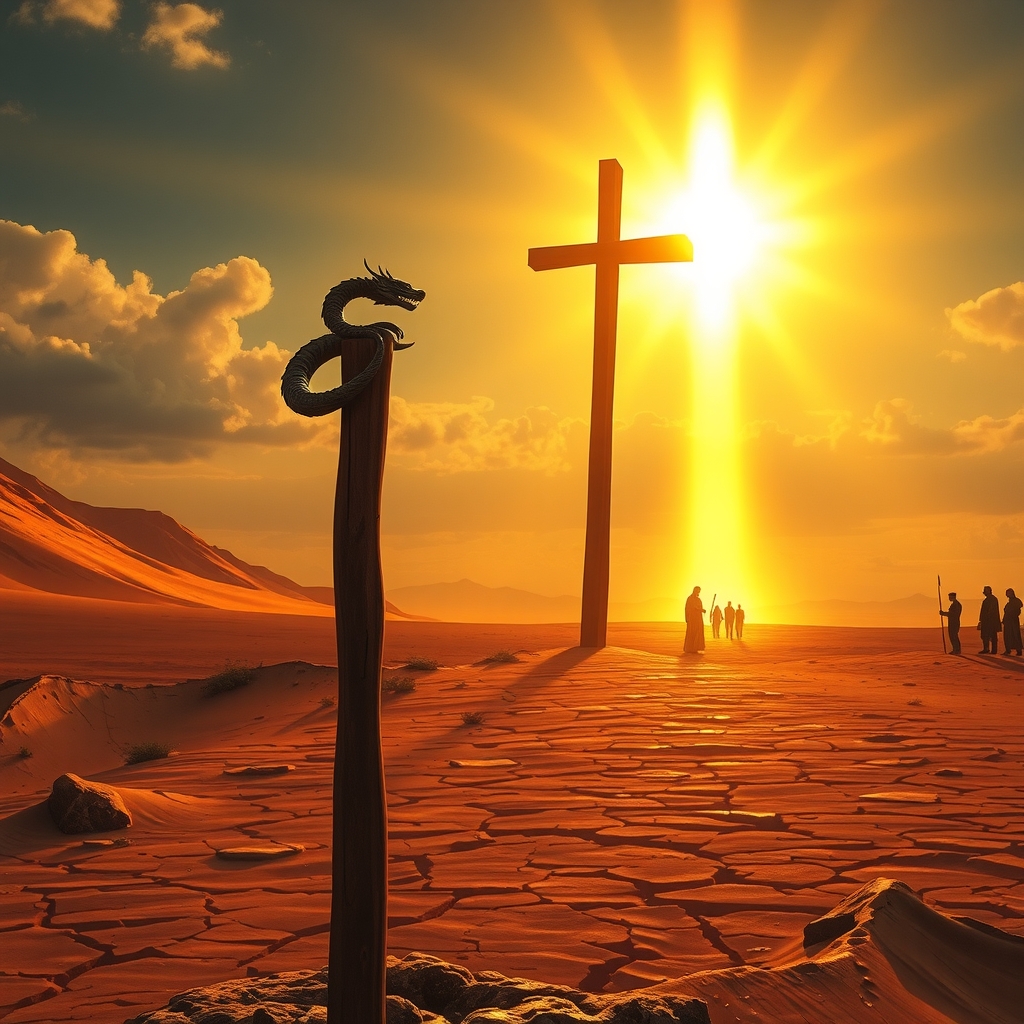
Moses obeyed. He made a bronze serpent and lifted it high. And whoever looked at it, lived.
Not the one who had earned enough merit. Not the one who no longer had symptoms. Not the one who had somehow paid his debt. The one who looked.
Jesus himself took that image and used it to explain what was going to happen on a cross:
"And as Moses lifted up the serpent in the wilderness, even so must the Son of Man be lifted up, that whoever believes in Him should not perish but have eternal life."
(John 3:14–15, NKJV)
The bronze serpent was not the final point. It was a sign. An announcement in the middle of the desert of something far greater that was coming. A Son of God lifted up high—not on a pole, but on a cross—so that whoever looked to Him would live.
Not Condemnation. Salvation.
There are people who approach God with fear. As if drawing near meant receiving a sentence. As if heaven were waiting with a list of everything they had done wrong.
But Jesus was clear about why He came:
"For God so loved the world that He gave His only begotten Son, that whoever believes in Him should not perish but have everlasting life. For God did not send His Son into the world to condemn the world, but that the world through Him might be saved."
(John 3:16–17, NKJV)
Not to condemn.
To save.
The cross was not a courtroom. It was a door.
And the wages that were ours to pay were paid by someone else. Romans 6:23 could not say it more clearly:
"For the wages of sin is death, but the gift of God is eternal life in Christ Jesus our Lord."
(Romans 6:23, NKJV)
The wages belonged to us. The gift was given to us.
That is grace. Not the word on a wall in the living room. The grace that abounded where sin abounded. The grace that took what we owed and gave us what we did not deserve.
The Tree of Life Is Open Again
What the garden lost, Christ restored.
Not as a metaphor. As reality.
At the end of the story—on the last page of the last book of the Bible—the tree of life appears again. And this time, there is no flaming sword blocking the way. There is an invitation:
"And the Spirit and the bride say, 'Come!' And let him who hears say, 'Come!' And let him who thirsts come. Whoever desires, let him take the water of life freely."
(Revelation 22:17, NKJV)
Freely.
At no cost. With no conditions to meet first. Without waiting until you are good enough.
Access was purchased by Christ. And access is received by faith.
Blessed are those who wash their robes, the text says. Those who come before Him not with their merits, but with their need. Those who look upward—as those in the desert looked at the bronze serpent—and simply believe that what He did is enough.
Perhaps you came to this article carrying something you don't quite know how to name. A void. A thirst you haven't been able to quench with anything the world offers.
That thirst is not a flaw. It is a sign.
It is your heart remembering—even if it doesn't know it—that you were made for more than survival. You were made to live—with God, in God, for God.
The thief has already stolen too much. Already killed too much. Already destroyed too much.
But Jesus keeps saying the same thing He said back then:
I came that you may have life. And that you may have it in abundance.
Look to Him.
And you will live.
Has this article helped you? Share it with someone who needs to hear this truth today.


