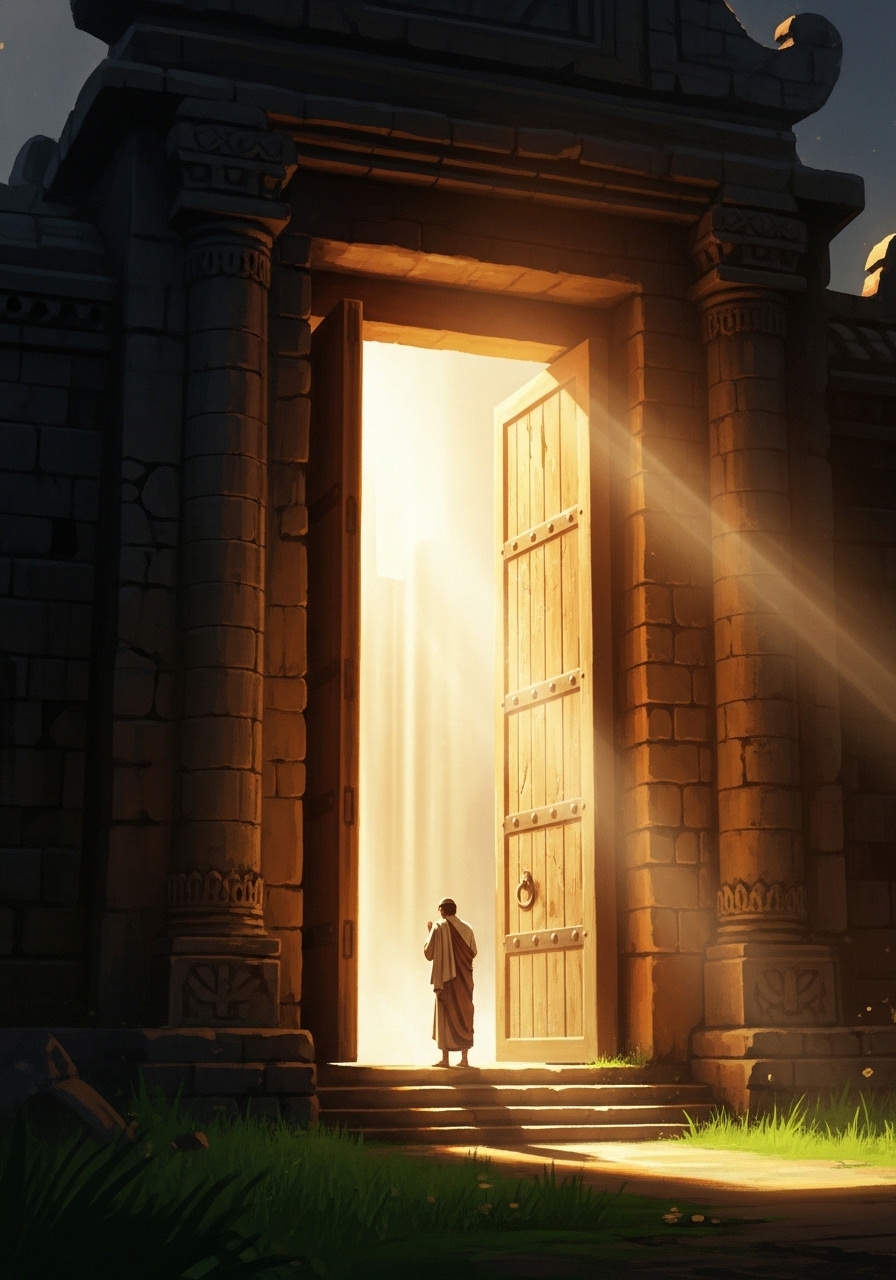
There are people who have been going to church for years and have never truly entered.
They're present. They sing. They raise their hands when everyone raises their hands. But on the inside — in that place where no one else can look — they're somewhere else entirely. Thinking about Monday's problem. Replaying the conversation that didn't end well. Weighed down by the exhaustion that almost kept them from showing up at all.
And when the service ends, they walk out the same way they walked in.
It isn't necessarily hypocrisy. It's that no one ever taught them how to enter.
"Enter into His gates with thanksgiving, and into His courts with praise. Be thankful to Him, and bless His name."
(Psalm 100:4, NKJV)
There is an architecture in this verse. A sequence. An order. And it is not accidental.
The Psalm Nobody Reads Slowly
Psalm 100 is one of the most quoted psalms in the entire Bible. It is also one of the most overlooked in its depth.
We know it by heart. We sing it in our churches. Sometimes we recite it almost without thinking.
But if you slow down — if you read it carefully, as though for the very first time — you'll notice it isn't simply a song of praise. It is an instruction. An invitation. A map for finding your way into the presence of God without getting lost along the way.
The psalmist doesn't merely say "worship." He says how.
"Make a joyful shout to the LORD, all you lands! Serve the LORD with gladness; come before His presence with singing."
(Psalm 100:1-2, NKJV)
Three commands in two verses: shout joyfully, serve, come. And every one of them shares a common thread we cannot afford to miss.
Joy is not the result of worship. It is the entry point.
First, Remember Who He Is
Before you reach the gates, there is a step that many people skip.
"Know that the LORD, He is God; it is He who has made us, and not we ourselves; we are His people and the sheep of His pasture."
(Psalm 100:3, NKJV)
This is the first gate.
Not the door of the church building. Not the entrance to the sanctuary. It is the gate of the mind and the heart — the moment when you decide, before you open your mouth to worship, to acknowledge who God is.
He made us. Not we ourselves.
That one line changes everything. Because in the world we live in, the dominant narrative runs exactly the other way. You build yourself. You define yourself. You are the architect of your own story.
That philosophy might play well at a leadership conference. But it doesn't hold up before God.
Before Him, we arrive with open hands, not folded arms. We come as sheep — dependent, guided by a shepherd, lost without Him — not as executives presenting their quarterly report.
True worship begins with that posture.
Before the music. Before the words. Before the first line of the song they put up on the screen.
The Gates Are Not Decoration
When God gave Moses the instructions for the tabernacle, He left nothing to chance.
"And let them make Me a sanctuary, that I may dwell among them. According to all that I show you, that is, the pattern of the tabernacle and the pattern of all its furnishings, just so you shall make it."
(Exodus 25:8-9, NKJV)
Everything had a purpose. The materials — gold, silver, bronze, fine linen, animal skins, acacia wood — were not arbitrary. The arrangement of the spaces was no architectural whim. There was an outer court, a holy place, and a Most Holy Place.
To reach God, you had to pass through each zone. You had to move through each curtain. There was a process.
"You shall make a screen for the door of the tabernacle, woven of blue, purple, and scarlet thread, and fine woven linen, made by a weaver."
(Exodus 26:36, NKJV)
That embroidered screen was not an obstacle. It was an invitation. It was saying to the worshiper: What is inside is holy. Enter differently than you entered the marketplace this morning.
The gates are not decoration. They are transition.
And in Psalm 100, the gates have two keys:
- Thanksgiving.
- Praise.
You cannot force the door. You cannot skip the process. Gratitude is not optional in worship; it is the key that opens the first lock.
Gratitude Comes First
There is a difference between asking and worshiping. And many times, what we call our "prayer time" is really a list of requests with a little music at the beginning.
That is not worship. That is spiritual administration.
Worship begins when you arrive with what you already have, not with what you still lack.
"For the LORD is good; His mercy is everlasting, and His truth endures to all generations."
(Psalm 100:5, NKJV)
Notice the foundation of gratitude in this psalm. It is not "because He healed me." It is not "because He blessed me this month." It is not "because everything worked out."
It is simply: because He is good.
His goodness does not depend on your circumstances. His mercy did not expire when you reached the worst chapter of your story. His faithfulness spans entire generations — those who came before you, your own, and those still to come.
That is what you carry in your hands when you enter through His gates.
Not your achievements. Not your merits. Not your years of service.
Just this: He is good. And I know it.
Enter Differently This Time
Perhaps you have spent a long time arriving at the threshold of God's presence and stopping there. Singing from the doorway. Praying from the outer court. But never crossing over.
The Holy Spirit is not asking you for more discipline or more effort. He is asking for a different posture.
Before you begin your devotional time today — before the next service starts at your church — pause and rest in these three realities:
- He made you. You are no accident, no product of chance. You have a Creator who knows you by name.
- He is good. Not just was good. Is good. Today, right now, in the middle of whatever you are walking through.
- His mercy has no expiration date. What you went through yesterday did not exhaust His grace for today.
Enter with that. Enter with real gratitude, not religious gratitude. Enter with praise that rises from what you already know about Him, not from what you are still waiting for Him to do.
The presence of God is not the prize at the end of the road. It is the reality you step into when you enter through His gates.
And He is waiting for you inside.


