There are things from your past that feel like they define you forever.
Not like a distant memory. Like a label stuck to your chest that no one else can see, but you carry it everywhere.
Prostitute. Failure. Unclean. Too far gone.
And the question beating beneath all of it is always the same:
Is there grace for someone like me?
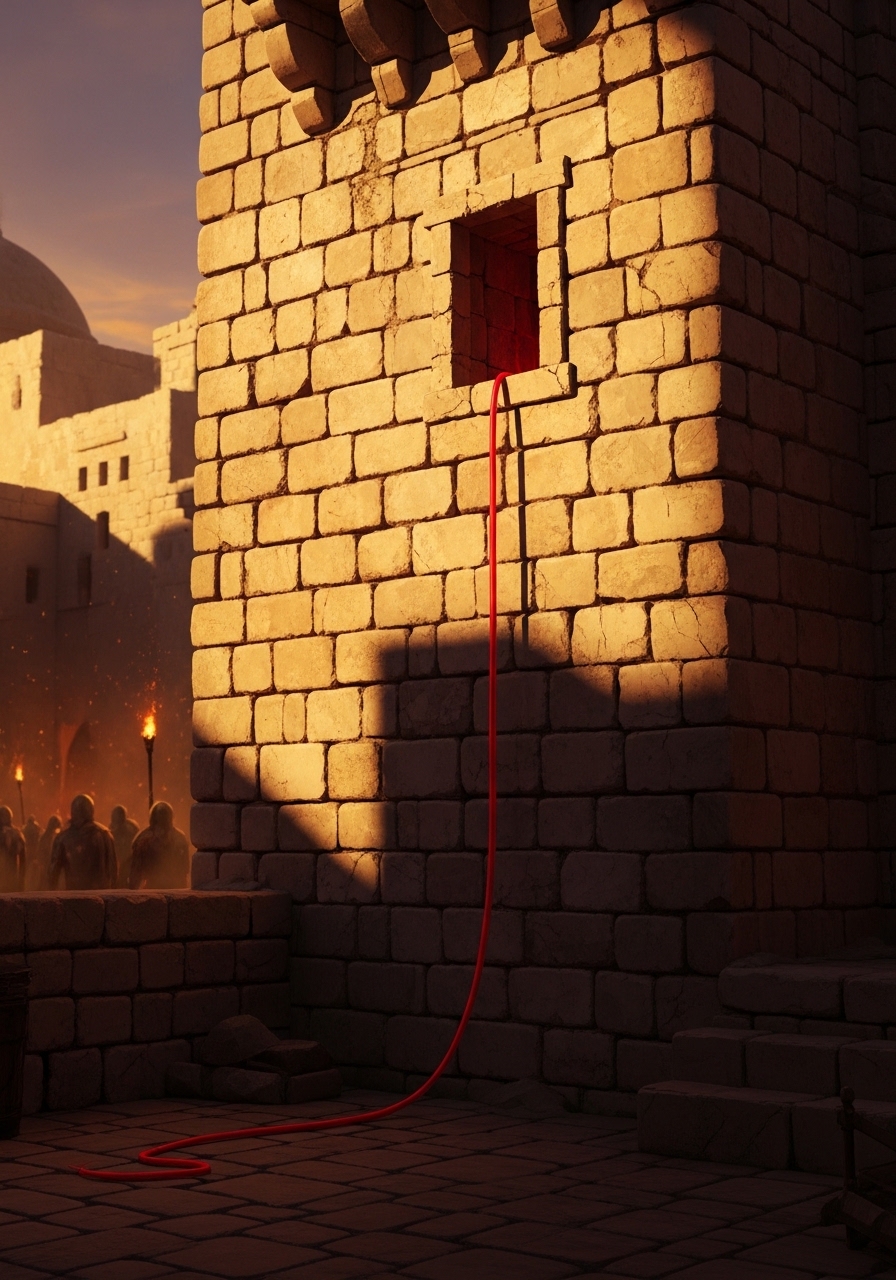
The answer isn't found in a theological argument. It's hanging in a window — on the wall of a condemned city — in the form of a scarlet cord.
A Woman Who Shouldn't Be in the Story
When Matthew opens his Gospel with the genealogy of Jesus, he does something no one expected.
"Salmon the father of Boaz, whose mother was Rahab, Boaz the father of Obed, whose mother was Ruth, Obed the father of Jesse."
(Matthew 1:5)
One name. In the direct line of Christ. A name that on any other list would have been erased, overlooked, or whispered in shame.
Rahab the harlot.
It is not a mistake. It is not an oversight of the Holy Spirit. It is a deliberate declaration of how God's grace works.
Because alongside Rahab, Matthew includes Tamar — whom her father-in-law mistook for a prostitute — Ruth — a descendant of the Moabites, born of incest — and Bathsheba — the wife of Uriah, who appears in the most shameful episode of David's life. Four women. Four marked lives. Four names that had no business appearing in the list of the Messiah's ancestors.
And there they are.
God does not erase the past. He redeems it.
The Woman on the Wall
The story of Rahab begins in Joshua 2. Two Israelite spies enter Jericho and lodge in the house of a harlot. That is not an accidental detail. It was the only kind of house where two foreigners could spend a night without raising suspicion.
But God was at work in that house.
The king of Jericho finds out and sends soldiers. Rahab hides the spies under stalks of flax on the rooftop. She protects them. She deceives their pursuers so they can escape. And then she says something that changes everything:
"I know that the LORD has given you this land… for the LORD your God is God in heaven above and on the earth below."
(Joshua 2:9, 11)
Stop right there.
That confession did not come from an Israelite priest. It did not come from a prophet with years of training. It came from a woman living on the wall of a pagan city, who had heard from a distance what God had done, and who believed before she saw.
That is called faith.
And faith — even when it springs up in the most unexpected place — God honors.
The Cord That Changed Everything
Before the spies left, they made a covenant with Rahab. The instruction was simple and absolute:
"Behold, when we come into the land, you shall tie this scarlet cord in the window through which you let us down, and you shall gather into your house your father and mother, your brothers, and all your father's household."
(Joshua 2:18)
A red cord. Hung in the window. That would be the sign.
Everyone inside would live. Anyone who went out would die.
There was nothing special about the thread itself. It was not magic. It was not a relic. It was a sign of trust in the word of the messengers. It was an act of faith made visible.
And when the day came — when the walls of Jericho collapsed with a thunderous crash and Israel's army swept through the city — there was one house left standing.
The one on the wall.
The harlot's.
The one with the red cord.
"By faith Rahab the harlot did not perish with those who were disobedient, because she had given a friendly welcome to the spies."
(Hebrews 11:31)
Faith that acts, saves.
Where Is the Harlot?
When John the Baptist saw Jesus coming toward him at the Jordan River, he pointed and said:
"Behold, the Lamb of God, who takes away the sin of the world!"
(John 1:29)
That word takes away in the original Greek is airō. It means to lift up, to raise, to place upon oneself and carry far away. It is not merely forgiving. It is taking the weight, bearing it, and removing it from you forever.
Like the scapegoat on the Day of Atonement in Leviticus 16: Aaron would lay both hands on the animal's head, confess over it all the iniquities of the people, and send it away into the wilderness.
"The goat shall bear all their iniquities on itself to a remote area."
(Leviticus 16:22)
It did not come back. It did not return carrying the sin. It was gone.
That is what Christ did. That is what the red cord was pointing toward, centuries before it happened.
The blood shed. The sign in the window. The promise that whoever is inside will live.
And the prophet Micah said it with an image that still sends a shiver through the soul:
"He will tread our iniquities underfoot. You will cast all our sins into the depths of the sea."
(Micah 7:19)
Not at the shore. Not within sight. In the depths.
Your Name Could Be on the List Too
Rahab did not clean up her story before she believed. She did not change her profession before she hung the cord. She did not present spotless credentials to the messengers.
She believed.
She acted on what she believed.
And God did the rest.
Her name ended up in the genealogy of the Savior of the world.
That is not a piece of biblical trivia. It is a direct message for you — for this very week — for that weight you carry and believe disqualifies you.
- It is not your past that determines your destiny. It is to whom you surrender that past.
- It is not the size of your failure that matters. It is whether you trust the One who can carry it.
- It is not the kind of person you have been. It is whether you believe that the blood of the Lamb reaches all the way to where you are.
The red cord is already available. The question is whether you are going to hang it in your window.
The Sign No One Can Take From You
When the walls fell, the spies kept their word. They entered the ruined city, found the house on the wall, and brought out Rahab, her father, her mother, her brothers, and all her relatives.
Everyone who was inside.
That is grace. Not a vague promise. A promise that seeks, that enters the middle of the ruins, and brings its own people out.
And today, Christ does the same.
You do not have to build yourself a new story before you come to Him. You can come just as Rahab came — with all your past in plain view, with the name they gave you, with the decisions you made.
And hang the cord.
Because He has already said:
"The grace of our Lord Jesus Christ be with all of you."
(Revelation 22:21)
With all.
Even you.
Even today.
Has this article ministered to you? Share it with someone who needs to know that God's grace reaches farther than we imagine.


